Queue Management System in Karachi: 2026 Setup Guide
Karachi moves fast, and its customers have no patience for standing still. Whether you run a pharmacy chain in Clifton, a hospital OPD in Gulshan, or a telecom service centre on Shahrah-e-Faisal, a well-designed queue management system in karachi is the difference between an orderly branch and a frustrated crowd. In 2026, the smartest operators are going one step further: they pair queue control with fast barcode scanning so that calling a customer and serving them happen in one smooth motion.
This setup guide explains how to plan, equip, and launch a queue system in a high-traffic Karachi branch — and why the scanner at the counter matters as much as the ticket at the door.
Why Karachi branches need structured queuing
Footfall in Karachi is both heavy and unpredictable. Power fluctuations, peak-hour rushes, and walk-in-heavy service models mean lines can form in minutes. A structured queue system does three jobs at once: it gives every visitor a fair, visible place in line; it routes each person to the right counter; and it records the data managers need to staff correctly.
Without that structure, branches fall back on the loudest-voice-wins model, which punishes polite customers and burns out staff. With it, even a sudden rush stays calm because everyone can see the system is fair.
The counter is where speed is won or lost
Calling the next ticket quickly is pointless if the agent then fumbles for two minutes looking up a product or prescription. That is exactly why high-performing branches put a reliable scanner at every counter. The Honeywell Orbit HF680 is a popular presentation scanner for this role because it reads both printed and on-screen (mobile) barcodes instantly, letting an agent verify an item, prescription, or loyalty card in under a second.
What equipment do you need to launch?
A complete, branch-ready queue deployment in Karachi usually comes down to a short, practical kit list:
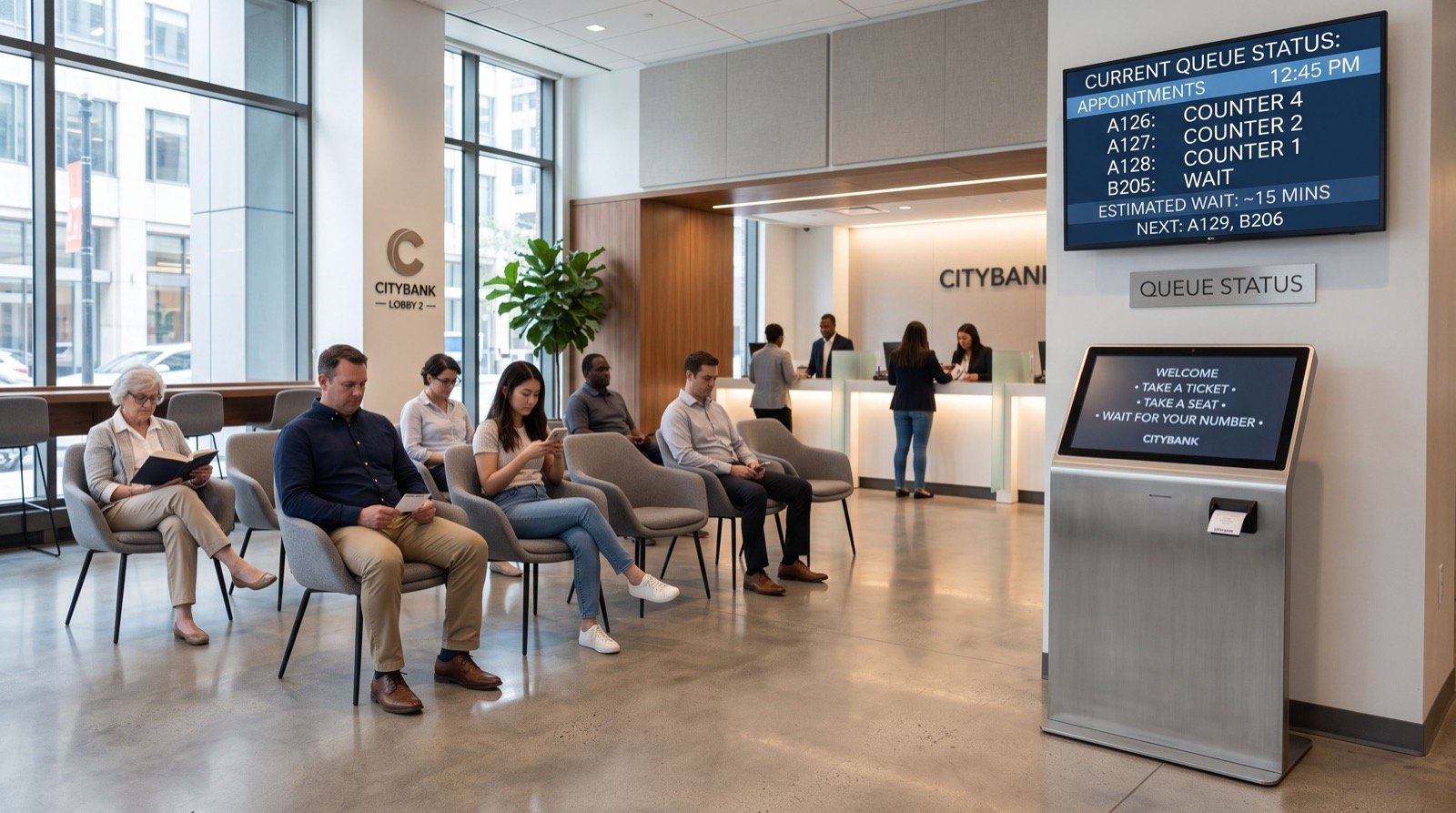
- Ticketing kiosk with service-selection buttons in Urdu and English.
- Main display and counter displays to call tickets visually and by voice.
- Counter software for agents to call, transfer, and recall customers.
- A presentation barcode scanner such as the Orbit HF680 at each service point.
- A UPS or battery backup — non-negotiable given load-shedding realities.
- SMS gateway so customers can wait outside and return when near the front.
Queue hardware comparison for a typical branch
Choosing components is easier when you see their role side by side. The table below maps each piece to its job and its 2026 priority level for a busy Karachi counter.
| Component | Primary job | Priority |
|---|---|---|
| Ticketing kiosk | Fair, visible check-in | Essential |
| Main LED display | Call tickets to the hall | Essential |
| Honeywell Orbit HF680 | Instant item / code capture | High |
| SMS notifications | Virtual, outside-the-hall waiting | High |
| Battery / UPS backup | Continuity during outages | Essential |
| Analytics module | Staffing & wait reporting | Medium |
Step-by-step launch plan
Rolling out cleanly matters more than rolling out fast. Follow this sequence to avoid the most common first-week problems:
- Audit your services. List every reason a customer walks in and the average time each takes.
- Design the counter layout. Place kiosks near the entrance and scanners within easy reach of each agent.
- Localise everything. Ensure tickets, signage, and voice calls work in Urdu and English.
- Integrate the scanner. Confirm the HF680 reads your product and prescription barcodes before go-live.
- Train and pilot. Run a soft launch for a week, watch the data, and tune counter allocation.
For procurement, installation, and ongoing maintenance it pays to work with quality service providers who stock genuine hardware and offer local support rather than importing one-off units with no warranty cover.
A field tip that saves real money
Here is a practical insight most buyers miss: standardise on one scanner model across all your branches. When every counter uses the same device, your spares pool is interchangeable, staff training transfers instantly, and a single faulty unit never shuts a counter down. Mixing models to save a few thousand rupees upfront almost always costs more in downtime later.
Keeping barcodes scannable
Scanner performance depends on barcode quality as much as the device. Follow globally recognised print standards from the GS1 organisation — correct quiet zones, adequate contrast, and verified symbol sizes. A premium scanner cannot rescue a smudged, undersized label, so treat label quality as part of the deployment, not an afterthought. For device-level specifications and firmware support, Honeywell’s own Safety and Productivity Solutions documentation is the authoritative reference.
Fitting the system to Karachi’s realities
A queue system designed for a European bank will stumble in Karachi if it ignores local conditions. Three factors deserve special attention during planning, and addressing them early prevents the most common first-month headaches.
- Power continuity — load-shedding is a fact of life, so every critical component needs battery backup, not just the server.
- Walk-in dominance — most Karachi customers arrive without appointments, so the kiosk and virtual-line flow must handle heavy, unscheduled footfall gracefully.
- Bilingual clarity — Urdu-first signage with English support keeps every visitor, literate or not, confident about their place in line.
Branches that plan around these realities from day one avoid the frustrating retrofits that plague deployments copied straight from an overseas template.
Measuring success after launch
Once the system is live, resist the urge to declare victory on day one. Real improvement shows up in the numbers over the following weeks. Track a small, honest set of metrics so you can prove the investment and fine-tune staffing.
Watch average wait time, average service time per counter, abandonment rate, and peak-hour throughput. If wait times stay high despite the system, the answer is almost always counter allocation rather than the technology itself — open more counters during the demand spike the analytics reveal. A weekly fifteen-minute review of these four figures keeps a busy Karachi branch sharp and steadily faster through 2026.
Frequently Asked Questions
How long does it take to install a queue management system in Karachi?
A single branch is typically live within a few days once hardware is on site. The planning and service audit beforehand usually take longer than the physical installation itself.
Why add a barcode scanner to the queue counter?
Because calling a customer quickly is wasted if the agent is slow to look up their item. A presentation scanner like the Orbit HF680 cuts per-transaction time, so the whole queue moves faster.
Does the system keep working during load-shedding?
With a UPS or battery backup, yes. Core ticketing and calling continue on local power, and cloud analytics resync once the main supply or internet returns.
Can the kiosk display Urdu?
Yes. Any system suited to Karachi should offer full Urdu and English for tickets, signage, and voice announcements, with Urdu as the default for local walk-in customers.
Conclusion
A queue management system in Karachi delivers its full value when the orderly line at the door meets a fast, scanner-equipped counter at the back. Plan around your real services, back everything up against outages, standardise your hardware, and keep your barcodes clean. Get those four things right in 2026 and your branch will feel faster to customers and run leaner for you. Start by auditing your busiest counter this week.